Inviting Feedback on STOA: Designing Transparency as a Human–Computer Interaction Problem
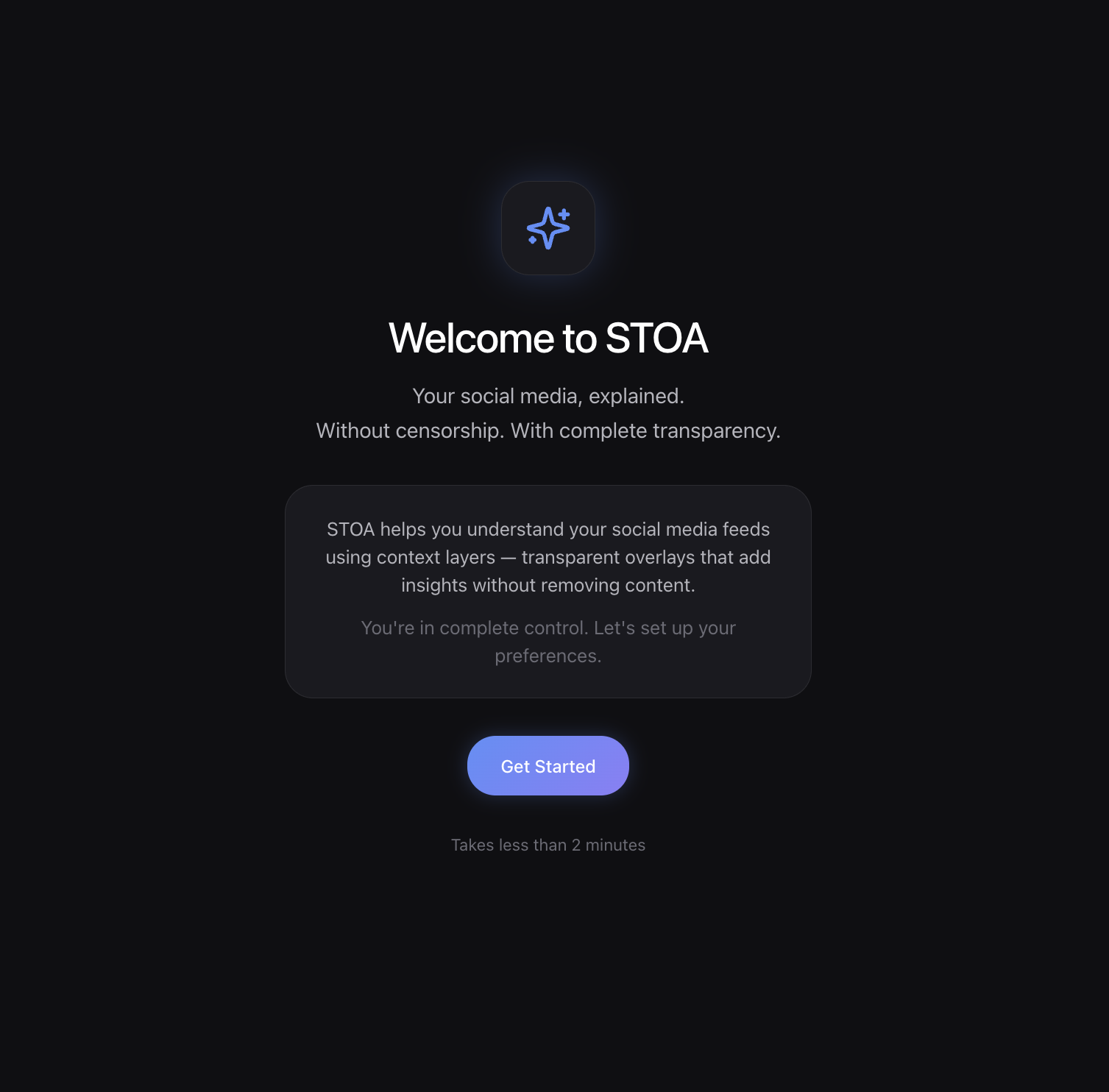
Digital platforms increasingly shape how people encounter information, exercise agency, and understand governance decisions that affect visibility, reach, and participation. Yet for most users, the reasoning behind these decisions remains opaque—experienced as outcomes rather than understood as processes.
Over the past year, we’ve been developing STOA (Standards for Transparent Online Agency) as a design research project that treats transparency not as a compliance artifact or technical disclosure, but as an interaction problem. The core question guiding this work is simple but challenging:
How might transparency be designed as a learnable, inspectable interaction that supports user understanding and agency—without requiring access to platform internals or exposing people to harm?
Research Focus
The current STOA prototype explores three interconnected research objectives:
Making governance reasoning legible through interaction
STOA investigates how contextual explanations—delivered through layered, user-invoked interface elements—can help people understand why content appears, how signals are interpreted, and which constraints are in play, without enforcing decisions or moralizing outcomes.Supporting social media literacy through design, not instruction
Rather than teaching rules or asking users to trust opaque systems, STOA emphasizes explanation patterns that support sense-making: confidence-qualified context tags, scenario-based prompts (e.g., “why might this be shown?”), and gentle agency cues that encourage reflection before sharing.Studying opaque governance systems without platform access
The prototype operates entirely on curated training datasets and simulated contextual signals. This allows us to study user understanding, trust calibration, and interpretive behavior without connecting to live platforms or personal social media feeds—minimizing ethical, legal, and privacy risks while enabling cross-context comparison.
This work is documented in an HCI paper currently in circulation among reviewers and collaborators. STOA is not a moderation tool, a platform product, or a regulatory proposal. It is a design research artifact intended to explore what usable transparency could look like at the interaction level.
Watch the Prototype Walkthrough (5 minutes)
Below, you’ll find a short walkthrough video demonstrating the current STOA interface, including:
the onboarding flow and age-appropriate context layers,
how contextual signals are surfaced and inspected,
how explanation patterns support inquiry rather than verdicts,
and how the design evolved in response to expert workshops and interviews.
Watching the video alone is sufficient to provide meaningful feedback.
Optional: Explore the Interactive Prototype
If you’d like to engage more deeply, you may also explore the interactive Figma prototype. The prototype uses fictional content and does not connect to live platforms or personal accounts. This option is entirely optional and intended for those who want to examine interaction details, explanation flows, or edge cases more closely.
We’re Inviting Feedback
We’re currently inviting feedback from researchers, practitioners, policymakers, educators, designers, and others working on related questions—particularly those engaged with:
human–computer interaction
algorithmic transparency and explainability
digital governance and platform accountability
media literacy and civic technology
rights-aligned and trauma-informed design
Feedback can be shared via a short form linked below. You’re welcome to comment on:
the clarity of the research claims,
the interaction model and design patterns,
potential risks or blind spots,
applicability to other contexts or populations,
or open questions the work raises.
There is no expectation to review the full paper or prototype. Any level of engagement is appreciated.
👉 Link to feedback form
👉 Link to prototype
Why This Matters
Transparency is often treated as something systems provide. STOA starts from a different premise: that transparency must be experienced, interpreted, and learned through interaction.
By inviting public feedback at this stage, we hope to surface critical perspectives, challenge assumptions, and strengthen the design and research before moving into larger pilots and future technical development.
Thank you for taking the time to engage with this work.